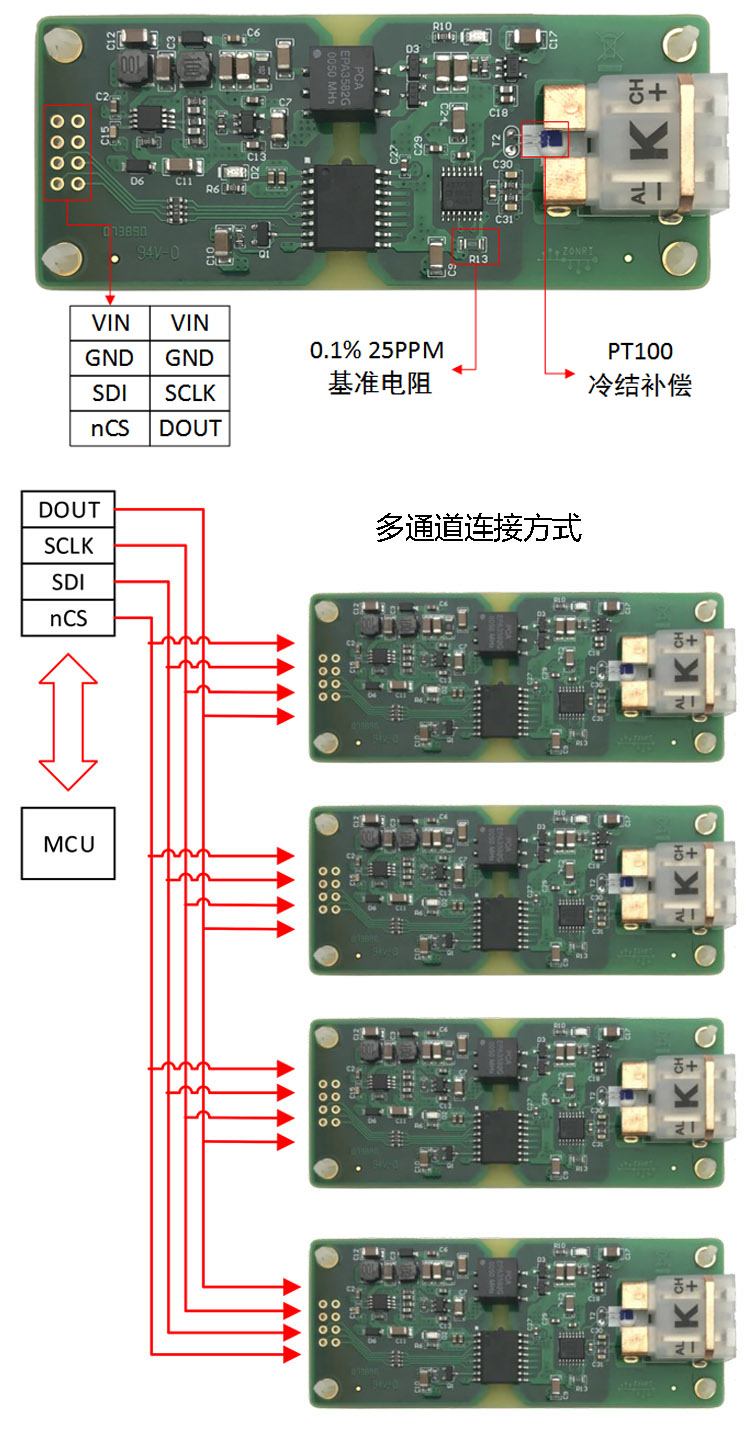
Parameters
A complete temperature measurement system based on AD7793, recommended document based on ADI CN0206_cn.
Using PT100 as cold junction compensation and 4-layer PCB cross temperature equalization wiring.
Support wide power supply voltage: 3-9VDC, typical current is 19mA when powered by 3.3V, and 12mA when powered by 5V.
SPI interface, supporting SPI multiplexing for multi-channel applications.
The maximum thermodynamic potential measurement range at 32 times gain is 36.5625mV, corresponding to a K thermocouple scale of 881 degrees Celsius.
The highest thermodynamic potential measurement range at 16 times gain is 73.125mV, covering the entire measurement range of the K thermocouple.
The minimum isolation voltage is 2500VDC.
The signal isolation chip is ADUM1401
Provide simulated SPI reference program (STM32F10X)
////////////////////////////////////////////////////////////////////////////////////////////////////////////////////////////////////////////////////////////////////////
Question: What is the temperature resolution?
Answer: The temperature resolution is about 0.03 degrees, and the typical noise is 0.085 degrees (that is, in a closed constant temperature environment, the temperature data read without a digital filter has a fluctuation amplitude of 0.085 degrees when the temperature is stable. When the thermocouple is exposed to air, the air flow can easily cause a fluctuation of more than 0.2 degrees)
Question: How to convert the thermoelectric potential read from the thermocouple into a temperature value?
Answer: Usually, the non-linear "thermoelectric potential temperature" is converted into temperature values using the lookup table method or segmented fitting method.